

AI has transformed ad budget management by automating decisions that previously relied on manual adjustments and outdated methods. Here’s how AI enhances ad performance:
- Real-Time Adjustments: AI reallocates budgets across campaigns and platforms every few minutes based on 200+ signals like conversion rates, audience overlap, and creative fatigue.
- Predictive Analytics: Machine learning forecasts future performance with 87% accuracy, helping marketers allocate budgets effectively.
- Data-Driven Attribution: AI evaluates every touchpoint in the customer journey, moving beyond last-click models to optimize ad spend across platforms.
- Proven Results: Businesses using AI see a 25–40% increase in ROAS, with case studies showing up to 82% reductions in cost per acquisition.
AI-powered tools like Google Smart Bidding and Ryze AI save time, reduce costs, and improve returns by making millions of micro-decisions humans can’t match. For marketers, integrating AI into budget management is no longer optional – it’s essential for staying competitive.
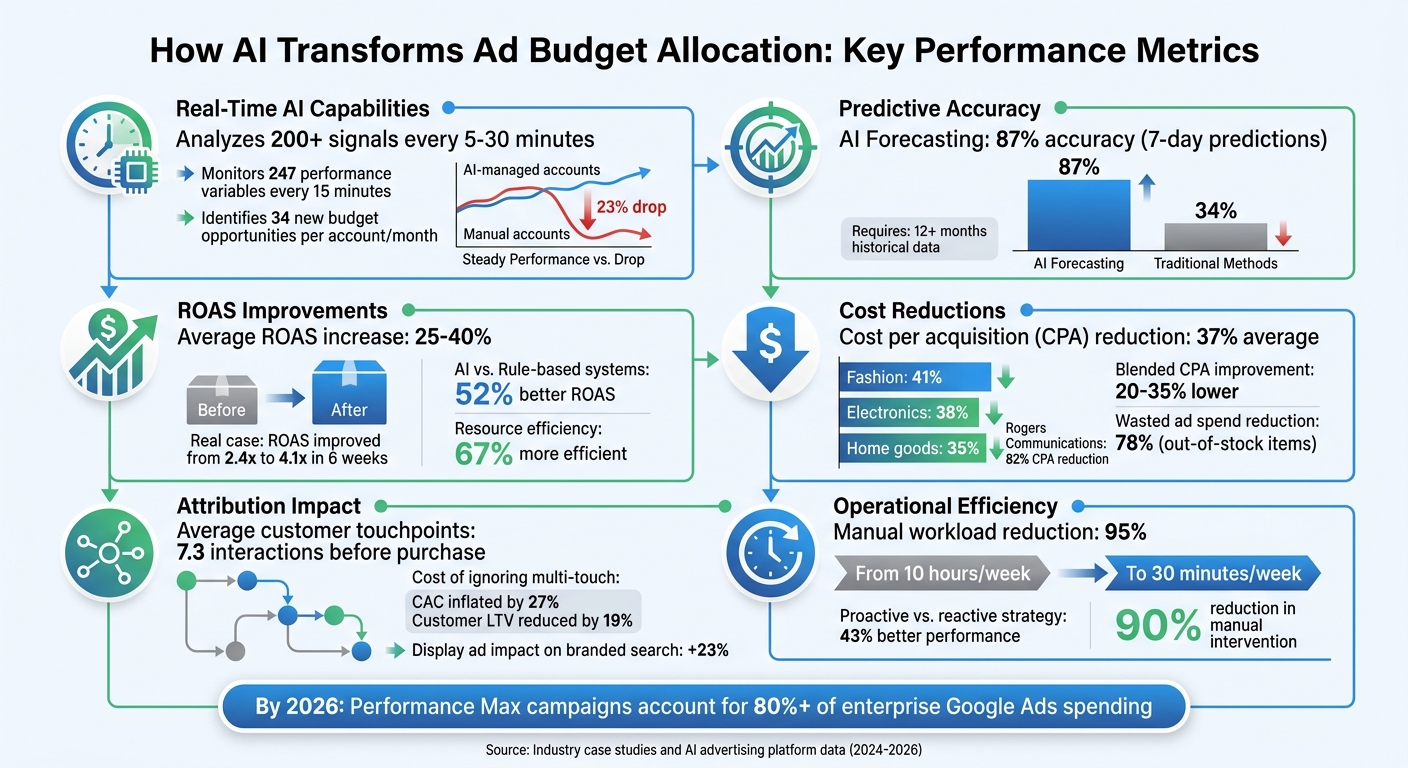
AI Ad Budget Optimization: Key Performance Metrics and ROI Improvements
Real-Time Budget Adjustments Using AI
Continuous Monitoring and Reallocation
AI takes budget management to the next level by analyzing over 200 signals – like click-through rates, conversion rates, cost per acquisition, audience overlap, and creative fatigue – every 5 to 30 minutes. This constant monitoring enables the system to detect performance changes and react instantly.
Here’s how it works: the system evaluates how much additional return each extra $100 could generate in a campaign. Based on this, it reallocates funds to the campaigns where they’ll deliver the most impact. If one ad group starts to underperform, the budget is shifted to campaigns showing stronger performance signals. These adjustments happen across and within channels.
AI doesn’t just make adjustments once or twice a day – it makes micro-adjustments every few hours or minutes. During high-competition periods, this precision pays off. While manual accounts often see a 23% performance drop, AI-managed accounts maintain steady efficiency throughout the day. Plus, AI eliminates human biases, like favoring newer campaigns, which can reduce manual efficiency by 19–26%.
This ability to make rapid, data-driven changes lays the foundation for measurable ROI improvements, as seen in the following case study.
Case Study: Real-Time Adjustments Improving ROI
The numbers speak for themselves. Rogers Communications showcased the impact of real-time AI adjustments in a 2024 case study. By integrating AI-powered call analytics with their ad platforms, they fed actual sales outcomes into the system. The AI then reallocated budgets toward high-profit customer segments as they were identified. The result? An 82% reduction in cost per acquisition.
Compared to rule-based systems, AI-driven budget allocation delivers 52% better ROAS and 67% more efficient resource use. For an e-commerce advertiser spending $20,000 a month, this translates to savings of around $2,400 per month.
sbb-itb-edfb666
Using Predictive Analytics for Budget Forecasting
Machine Learning Models for Accurate Forecasts
AI doesn’t just focus on the present – it predicts the future. By analyzing historical data, predictive models can forecast metrics like conversion rates, customer lifetime value, and future spending requirements, achieving an impressive 87% accuracy for 7-day performance predictions. Compare that to the 34% accuracy of traditional historical averaging methods, and the advantage becomes clear.
These systems rely on at least 12 months of historical data to create dependable baselines. They dig into metrics like click-through rates, conversion trends, cost per acquisition, and CRM purchase histories. Advanced ensemble models, which blend decision trees, neural networks, and regression techniques, take this a step further by delivering precise budget forecasts.
What sets AI apart is its focus on value-based bidding rather than simple conversion tracking. Instead of just chasing volume, it assigns proxies for revenue or customer lifetime value to leads, optimizing for profitability. This means the algorithm can determine which $100 increment will generate the best return – and it continuously recalculates in real time.
Beyond these predictions, AI also uses scenario simulations to refine budget allocation strategies, ensuring every dollar is spent wisely.
Scenario Simulations for Better Budget Decisions
Before committing to additional spending, AI tools simulate potential outcomes. These scenario simulations allow marketers to test different budget allocation strategies by modeling variables like spend limits and saturation points. They can identify short-term opportunities, such as competitive lulls or seasonal trends, enabling timely budget shifts.
This proactive approach can boost campaign performance by 43% compared to reactive strategies. AI systems monitor 247 performance variables every 15 minutes, uncovering an average of 34 new budget allocation opportunities per account each month. For example, if Meta‘s ROAS drops by 20%, the AI can detect this within hours and reallocate the budget to Google, ensuring the campaign stays on track.
To maximize the benefits of these simulations, leverage tools like Google’s Bid Simulator to evaluate trade-offs before scaling. Adjust for seasonality to account for temporary conversion rate spikes during sales events. Finally, set diversification constraints – no single campaign should control more than 60% of the total budget – to avoid audience saturation.
AI-Driven Multi-Channel Attribution Modeling
Tracking Touchpoints Beyond Last-Click Attribution
AI is transforming how businesses understand and value customer interactions by moving beyond the outdated last-click attribution model. Traditional last-click attribution gives all the credit for a conversion to the final interaction – like a branded search – while ignoring earlier touchpoints that play a crucial role in the customer journey. For example, a YouTube video or a Facebook ad might introduce a customer to a brand long before they make a purchase. On average, modern consumers engage with a brand 7.3 times before deciding to buy.
AI tackles this issue with data-driven attribution (DDA), which distributes credit across all touchpoints based on their actual contribution to the conversion. Instead of relying on guesswork, machine learning evaluates hundreds of factors – like click-through rates, the time between interactions, and even the devices used – to calculate each touchpoint’s influence. Ignoring this approach and sticking to last-click attribution can inflate customer acquisition costs by 27% and reduce customer lifetime value by 19%.
"Upper-funnel campaigns that contribute to conversions without receiving last-click credit receive appropriate budget allocation based on their actual impact on customer acquisition and revenue generation." – groas.ai
By assigning fractional credit to every touchpoint, AI also uncovers how campaigns work together. For instance, it might reveal that a display ad boosts branded search conversions by 23%. This level of insight allows businesses to reallocate budgets more effectively, ensuring every dollar is spent where it matters most.
Improving Cross-Platform Budget Allocation
AI doesn’t just redefine how touchpoints are valued – it also helps optimize ad spend across platforms. While individual platforms like Meta or Google focus on maximizing results within their own ecosystems, cross-platform AI tools take a broader view. These tools monitor marginal return on ad spend (ROAS) across all campaigns, enabling smarter budget shifts when certain channels become less efficient. For example, if Meta’s cost per acquisition rises or Google’s auctions become overly competitive, the AI can redirect funds to the platform offering cheaper conversions. This strategy has been shown to lower blended CPA by 20–35%.
"Cross-platform AI tools sit above both platforms, monitoring marginal ROAS across all campaigns in real time. Neither considers the other [in siloed management]." – Leo Answer Library
A great example comes from Brooklinen, which used AI alongside Meta’s Advantage+ shopping campaigns. This integration led to a 45% boost in conversions and a 12% reduction in CPM.
To make the most of these tools, businesses need to provide high-quality data. Server-side tracking and enhanced conversions are critical for accurately linking customer behavior – like researching on mobile but completing a purchase on desktop. Additionally, setting diversification constraints prevents the AI from over-investing in a single high-performing campaign, which could lead to audience fatigue. These strategies ensure that both attribution modeling and cross-platform optimization work hand in hand to maximize ad spend efficiency.
Proven ROI Outcomes from AI in Advertising
Case Studies Showing ROAS Improvements
The numbers are clear: AI-powered strategies are driving measurable gains in return on ad spend (ROAS). Businesses that adopt AI-driven budget allocation report an average ROAS of 3.8x within just six weeks.
Take FitFlow Direct, for example, a fitness equipment retailer that had been stuck at $2.5 million in annual revenue for two years due to the limitations of manual bidding. Enter AI-driven Smart Bidding, and the results were game-changing. Founder David Park shared:
"Smart Bidding broke through that barrier by finding profitable customer segments we never would have discovered manually."
Another compelling example comes from an unnamed e-commerce agency that switched to Ryze AI’s autonomous budget management. The results? A 95% reduction in manual workload and a leap in their client’s ROAS from 2.4x to 4.1x in just six weeks. Paid media manager Sarah K. explained:
"We went from spending 10 hours a week on bid management to maybe 30 minutes reviewing Ryze’s recommendations. Our ROAS went from 2.4x to 4.1x in six weeks."
Google’s beta analysis of 50,000 e-commerce advertisers using enhanced Smart Bidding from January to March 2026 further solidifies the case for AI. Across various industries, advertisers saw a 37% drop in cost per acquisition (CPA) and a 31% boost in ROAS. The breakdown by vertical is equally impressive: fashion retailers achieved a 41% CPA reduction, electronics saw a 38% decrease, home goods came in at 35%, luxury goods at 22%, and B2B e-commerce at 18%.
These examples highlight how AI is reshaping advertising performance – and set the stage for its impact on Amazon PPC campaigns.
Impact on Amazon PPC Campaigns
AI’s influence isn’t limited to traditional platforms; it’s making waves in specialized marketplaces like Amazon. The latest AI-driven systems now factor in real-time inventory levels and profit margins when managing bids. This means ad spend is automatically reduced for out-of-stock products while prioritizing high-margin items with sufficient inventory. The result? A 78% reduction in wasted ad spend on out-of-stock items and a 23% improvement in inventory turnover rates.
Cross-platform AI tools also monitor marginal ROAS in real time, reallocating budgets from underperforming channels to those delivering better results. This approach typically leads to 15–25% higher blended ROAS and a 20–35% reduction in overall CPA. For Amazon, where auction dynamics can change by the hour, this real-time adaptability prevents efficiency losses of 34–47% – a common issue with rule-based systems.
Budgets, bidding & AI-powered campaigns: Best practices for 2026
Conclusion: The Future of AI in Ad Budget Allocation
Shifting from manual processes to AI-driven budget allocation is transforming advertising. AI can process massive amounts of real-time data and make millions of micro-decisions that would be impossible for any human team to match. Businesses leveraging AI for this purpose are seeing far better resource efficiency and returns compared to traditional rule-based systems.
The future of AI in this space is heading toward autonomous decision-making, reducing the need for manual intervention by 90%. These systems won’t just optimize budgets within a single platform – they’ll adjust spending across platforms like Google and Meta dynamically, based on marginal ROAS (Return on Ad Spend). Beyond basic metrics like clicks or leads, AI will prioritize real business outcomes such as profit margins, inventory levels, and customer lifetime value.
The competitive landscape is evolving quickly. AI-managed accounts maintain steady performance throughout the day, while rule-based systems experience a 23% drop in efficiency during peak competition times. This marks a major shift, as AI begins to take on strategic, autonomous decision-making in budget management.
For companies, the stakes are high. Waiting too long to adopt AI could mean falling behind competitors permanently. Omar Jenblat, CEO of BusySeed, highlights this critical point:
"AI reallocates spend toward perceived efficiency, not business outcomes. Understanding those incentives is the difference between scale and silent bleed."
As Performance Max campaigns already account for over 80% of enterprise-level Google Ads spending by 2026, it’s clear that AI is no longer just an optional tool – it’s becoming a strategic partner in advertising. The real question isn’t whether to integrate AI into your strategy, but how fast you can make it happen.
FAQs
What data do I need for AI to optimize my ad budgets?
To make the most of your ad budgets, AI relies on real-time performance data. This includes metrics like conversion rates, click-through rates, cost per acquisition, and insights into audience behavior, seasonal trends, and competitive pressures. By analyzing this data, AI can allocate resources more effectively, ensuring your ad spend works harder and delivers better results.
How long does it take AI bidding to improve ROAS?
AI bidding has the potential to boost ROAS (Return on Ad Spend) in a surprisingly short time. Many advertisers report seeing noticeable improvements within just 2 to 4 weeks of implementation. While results can differ based on factors like how well the campaign is set up and the quality of the data being used, the speed at which AI adjusts and optimizes bids often translates to quicker performance gains.
How can I keep AI from overspending on one channel or audience?
To keep your spending in check, consider using AI-driven systems that can tweak budgets in real-time based on performance metrics like conversion rates and audience activity. By setting clear minimum and maximum spend limits, you can ensure your resources are evenly distributed across different channels. Advanced tools with predictive capabilities take it a step further by automating these adjustments, helping you allocate funds efficiently without over-prioritizing one audience or platform.